Designing Shadow Puppet Projection Game
Light and occlusion become mechanics and metaphor when a player shifts a beam to reveal hidden pathways, animate lost figures and reconstruct a vanished craft. This text condenses historical roots, technical practice and contemporary creative pathways that inform a projection game built around shadow puppet adventure, with concrete guidance for designers, educators and cultural custodians.
Historical, Technical and Practical Perspectives
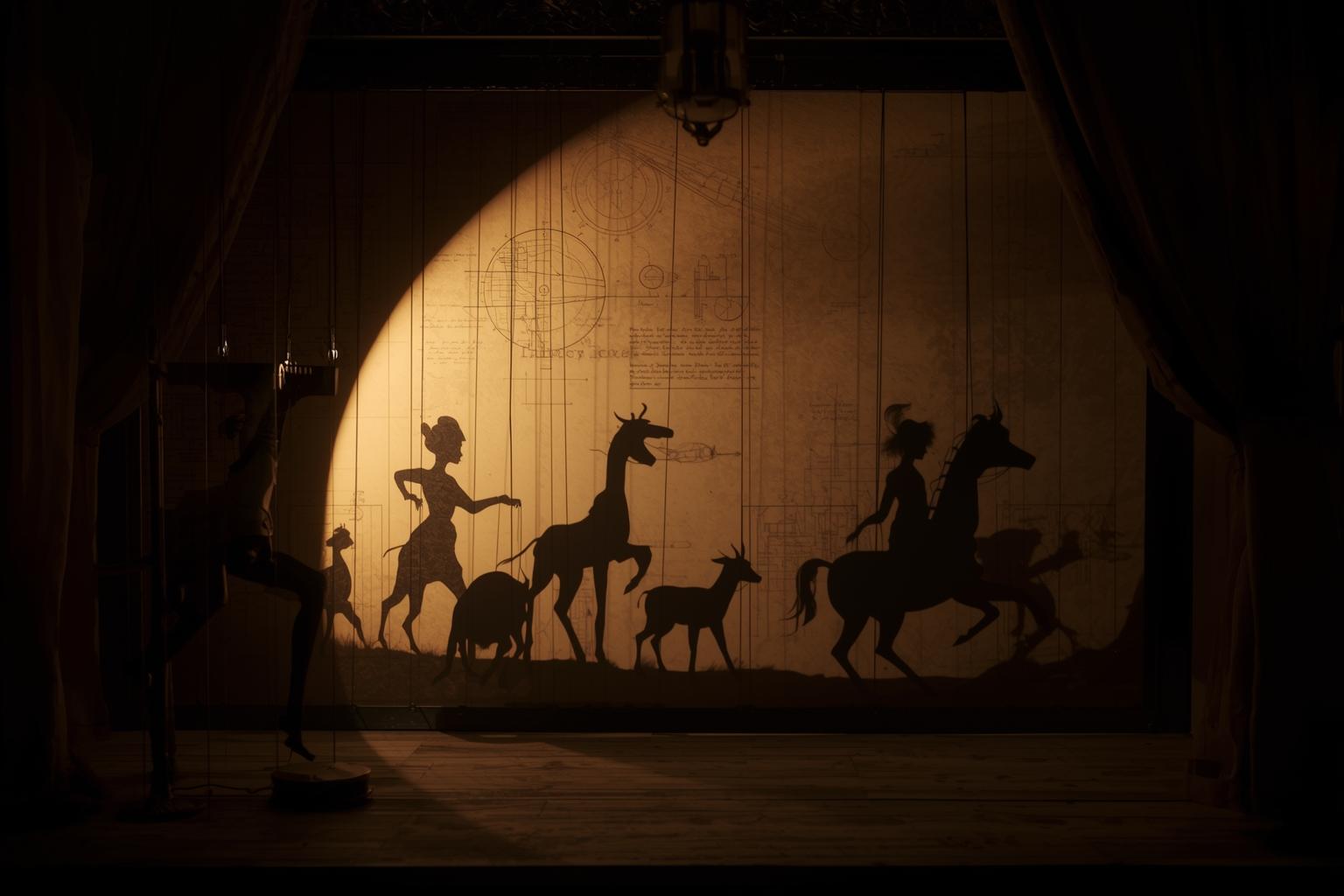
Shadow practices trace back millennia. Early Chinese shadow theatre has references from Han dynasty sources around the first centuries BCE and CE, when silhouette plays accompanied court ritual and storytelling. Indonesian Wayang Kulit evolved into a complex ritual and narrative form by the first millennium CE and was recognized by UNESCO in 2003 as a living heritage. Ottoman and Turkish Karagöz traditions became prominent in the 16th century and spread through Mediterranean performance networks. Indian shadow traditions such as Tholu Bommalata and Ravanachhaya are documented from early medieval inscriptions and temple records. European silhouette work and cutout animation reached a global audience through Lotte Reiniger’s 1926 silhouette feature The Adventures of Prince Achmed, which directly informs cinematic use of backlit cutouts.
The physics that make shadow art legible are simple yet exacting. An occluder placed between a light source and a surface casts an umbra and a penumbra. Crispness depends on source size and distance: point-like sources yield sharp silhouettes while extended sources create soft edges. Projection geometry follows inverse square falloff; luminance drops with distance, so a 2,000 lumen projector will deliver markedly lower lux on a large screen than on a small one. Practical ranges for live installations tend to use projectors in the 1,000–5,000 lumen class with contrast ratios above 2,000:1 to maintain silhouette clarity in dim rooms. LED lamps offer low heat, long life and instant modulation; halogen sources provide warm color but require heat management.
Materials and manual technique remain central. Traditional puppets use animal hide, oiled parchment or thick card with jointed limbs on metal rivets; handles are bamboo or lightweight metal. Contemporary makers often choose black PVC foam, 200–350 gsm cardstock or laser-cut plywood for durability, and attach 1.5–2 mm steel rods for control. Hand silhouettes depend on gesture economy: a small change in finger separation can transform a bird into a bridge. Precision tools include scalpels, laser cutters and rotary punches, but the craft imperative is legibility under projection rather than ornamental detail.
Digital projection mapping and software tools allow complex alignment between physical puppets and projected textures or dynamic light. Systems commonly pair Unity or Unreal Engine for real-time physics with mapper tools such as Resolume and TouchDesigner for visual composition. Open-source frameworks like OpenFrameworks and Processing enable custom shader work, while depth sensors such as Kinect or LiDAR provide live occluder tracking for responsive shadow behaviour. Mobile devices with LiDAR now support AR shadows that react to real geometry, useful for prototypes and small-scale exhibitions.
Shadow language in moving image work has both practical and poetic uses. Reiniger’s silhouette animation established how backlit cutouts can carry entire narrative weight without facial detail. Modern cinema borrows shadow for suspense and moral ambiguity; chiaroscuro lighting places characters at the edge of visibility to signal unreliability or hidden motive. On streaming platforms, low-key lighting and silhouette reveal function as shorthand for mystery across genres.
Public installations and immersive exhibitions show how interactivity shifts spectators into co-creators. Projects by collective studios combine motion tracking, projection surfaces and tactile props to invite visitors to shape the story through gesture. Video games have adapted the aesthetic: Playdead’s Limbo (2010) and Inside (2016) use silhouette environments to emphasize silhouette navigation and environmental puzzles. Indie titles increasingly embed light manipulation as a core mechanic, pairing physical intuition with level design that rewards experimentation.
Practical comparisons across traditions and technologies clarify design choices:
| Region / Practice | Earliest Documentary Reference | Typical Materials | Distinctive Technique | Contemporary Interface Examples |
|---|---|---|---|---|
| China shadow theatre | Han dynasty, ca. 1st century BCE–1st century CE | Leather, parchment | Backlit flat figures, color filters | Digital backdrops with layered silhouettes |
| Indonesia Wayang Kulit | Formalized by 9th–10th century CE | Water buffalo hide, painted leather | Intricate carving, gamelan accompaniment | Interactive projections mapping to puppets |
| Ottoman Karagöz | 16th century Ottoman records | Cardboard, painted panels | Improvisational comedy, live dialogue | Live actor shadow capture with projection |
| India Tholu Bommalata | Early medieval temple records | Thin leather, coloured translucent paint | Large palace-scale screens | AR overlays aligning to traditional motifs |
| European cutout animation | 18th–19th century silhouettes; Reiniger 1926 | Paper, card, wire joints | Frame-by-frame silhouette animation | Real-time silhouette rigs in game engines |
A focused case study illuminates design tradeoffs for a projection game about lost craft. Mechanics center on manipulating a point or directional light to reveal layered narratives written on translucent screens. Players rotate lanterns, position cutouts and sequence music cues that unlock memories. Visual decisions favor matte black occluders to maximize contrast, and level geometry uses scale changes to translate puppet motion into platforming challenges. Sound follows shadow: subtle creak or breath cues at occlusion transitions increase immersion and guide exploration without relying on text.
Narrative function arises from economy: shadows convey identity, intention and shift in power. A character revealed first as a silhouette retains mystery; later detailing can be used as plot payoff. Symbolic resonances draw on mythology and psychology. Jungian shadow motifs and Plato’s cave provide interpretive layers, while folk narratives embed shadows as omens or companions in many cultures.
Preservation of craft requires reciprocity. Workshops, archival digitization and direct collaboration with tradition bearers prevent extraction. UNESCO recognition of Wayang Kulit in 2003 offers one model for safeguarding living practice. Educational application is concrete: STEAM curricula can pair optics lessons with puppet making, teaching geometry, fabrication and narrative design through hands-on modules that scale from elementary classrooms to university labs.
Designing accessible experiences means considering contrast, alternate audio navigation, and controls that do not demand fine motor precision. Ethical practice includes cultural attribution, fair compensation for artisan knowledge and avoiding literal appropriation of sacred motifs. Technical constraints are pragmatic: ambient light, power, transport and venue geometry limit scale; solutions include modular projection rigs, battery-powered LEDs and adaptive calibration routines.
Future directions integrate AR, VR and generative systems. Artificial intelligence can synthesize occluder patterns that respond to player emotion, while AR offers personal shadow stages on tabletop surfaces. Best outcomes arise when technologists and tradition carriers co-design, sharing methods, authorship and benefits. For continued learning, seek museums with performance programs, university labs working on embodied interaction, and practitioner forums that document craft techniques, archival sources and software recipes.
© shadowplaystudios.com. All rights reserved